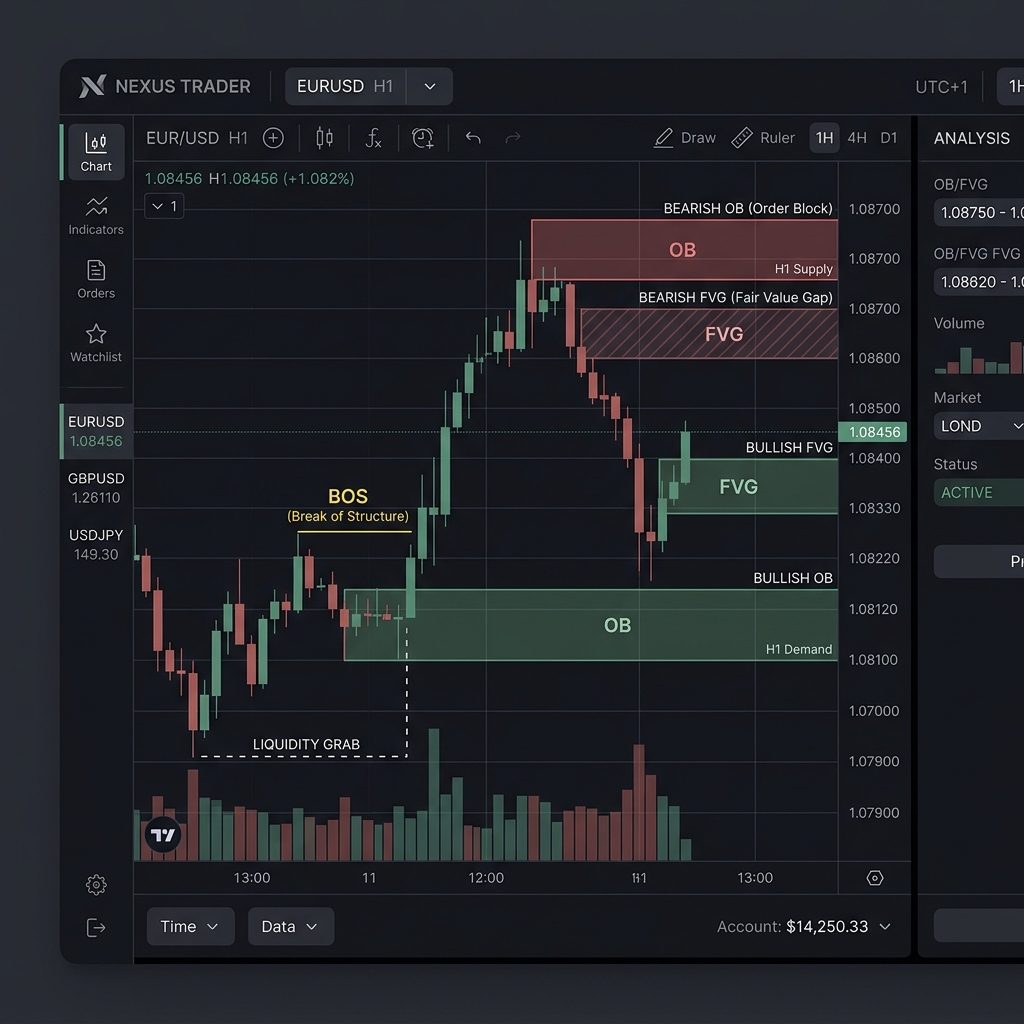
Breakout strategies that buy simply because price has pushed above a resistance level fail more often than traders expect. In SMC, that kind of false break is interpreted not as noise but as a deliberate liquidity collection by smart money. This article covers the definition of the Turtle Soup counter-trend method, its step-by-step entry procedure, and the common pitfalls that trip up new practitioners.
Turtle Soup and SMC: Definition and Mechanics
The name Turtle Soup comes from the idea of inverting the Turtle Trader method that gained popularity in the 1980s. Turtle Traders enter in the direction of breakouts above recent highs or below recent lows; Turtle Soup does the opposite, entering against the move when that breakout is judged to be a fake-out.
Within the framework of SMC (Smart Money Concepts), this false break is not treated as random price action. It is interpreted as a Liquidity Sweep deliberately engineered by large institutional players. Concretely, when price pushes above a recent swing high, all the sell-side stop-loss orders clustered there are triggered at once. Institutions absorb that liquidity while building sizable short positions, then drive price back in the opposite direction. This liquidity sweep to reversal pattern is the core of the Turtle Soup method.
The same logic applies on the swing low side: price breaks below a recent low, buy-side stops are swept, and price snaps sharply back up. Confirming a reversal requires observing a Market Structure Shift (MSS). If, after the liquidity sweep, price takes out the immediately preceding swing point in the opposite direction, an MSS is considered established and the case for entry strengthens. For how Turtle Soup combines with other SMC concepts such as PD arrays, order blocks, and fair value gaps, visit the SMC Learning Hub to build your foundation.
Step-by-Step Entry Procedure and Risk-Reward Calculation
Below is an example of a short entry using a liquidity sweep at a swing high. Assume a USD/JPY 4-hour chart where the high of the past three days (say, 157.50) has become the key level.
- Price breaks above 157.50 and rises to 157.70-157.85 (liquidity sweep occurs)
- Price drops sharply within 1-2 candles, falling back below 157.50 (false break confirmed)
- The preceding swing low (e.g., 157.10) is taken out – MSS established
- Wait for a pullback and enter short near 157.50
- Place stop loss beyond the sweep high (e.g., 157.90)
- Target the nearest liquidity pool (e.g., cluster of lows near 156.50)
| Item | Reference Value (Example) | Rationale |
|---|---|---|
| Entry | Near 157.50 (pullback) | Point where former resistance flips to support |
| Stop Loss | 157.90 (beyond the sweep high) | Placed outside the liquidity collection zone with adequate buffer |
| Profit Target | 156.50 (next liquidity pool) | Location of recent swing lows and uncollected sell-side liquidity |
| Risk-Reward Ratio | Approx. 1:2.5 | (157.50 – 156.50) / (157.90 – 157.50) = 1.00 / 0.40 = 2.5 |
The risk-reward ratio formula is as follows.
RR = (Entry Price - Target Price) / (Stop Loss Price - Entry Price)
In the example above, RR = (157.50 – 156.50) / (157.90 – 157.50) = 1.00 / 0.40 = 2.5. The Turtle Soup method is structurally designed so that the amplitude of the sweep and the distance to the target naturally push the RR ratio higher. This is why a positive expected value is achievable even with a win rate below 50% – though that statement only holds when the parameters are grounded in backtesting data. Add slippage and spread, and the numbers will shift. See also Caveats for Using Profit Factor as a Performance Metric.
Common Pitfalls for Beginners
- Entering before the candle closes: A liquidity sweep can only be confirmed once the candle has fully closed. Deciding that a sweep has occurred while the candle is still forming and entering early can trap you in a genuine breakout. On the 4-hour chart, the basic rule is to judge based on a fully closed candle – one where the full four hours have elapsed.
- Fading the market without confirming MSS: Even after a sweep occurs, the case for a reversal is weak until an MSS (the preceding swing point being taken out in the opposite direction) is confirmed. Skipping this step is common and causes win rates to drop sharply. Confirming MSS is non-negotiable – it is the only reliable way to distinguish a true reversal from a running liquidity pattern where price continues in one direction after the sweep.
- Trading against the higher-timeframe trend: Attempting to short a 4-hour swing high sweep while the daily or weekly chart is in a clear uptrend is a classic mistake. SMC requires alignment with the higher-timeframe directional context. If the higher timeframe is trending up, prioritize long entries off swing low sweeps instead.
- Placing the stop loss inside the sweep high: Volatility runs high immediately after a liquidity sweep, and a stop placed just inside the sweep high is liable to be triggered again. The standard approach is to set the stop a few pips beyond the sweep high, leaving adequate buffer. A stop that is too tight significantly erodes the strategy’s expected value.
- Ignoring major news release windows: Spreads widen sharply around releases such as U.S. Non-Farm Payrolls and FOMC announcements, generating sudden moves that are difficult to distinguish from ordinary sweeps. It is effective to check the economic calendar in advance and apply a rule of avoiding entries within 30 minutes before and after a release. Automated trading with EAs carries the same risk, so review Key Metrics for EA Backtesting and Verification alongside this guide.
FX AI Lab View
Behind Turtle Soup’s straightforward concept lie multiple interlocking conditions: higher-timeframe context, the precise location of liquidity, and the correct identification of an MSS. Because these are difficult to reduce to rigid rules, the method tends to be highly practitioner-dependent, and producing consistent results requires defining each condition with precision. The FX AI Lab is conducting ongoing research into encoding this method into AI logic, and findings will be published on this site as they become available. If you are interested in applying this to live trading, please review the SMC foundational materials in the Library and consider an experimental allocation through an HFM Copy Trade Account.
Related Links
This article is provided for informational purposes only and does not constitute a recommendation to buy or sell any specific financial instrument or trading method. FX trading carries no guarantee of principal, and leverage can cause losses to exceed the amount invested. Before trading, please review the Risk Disclosure page and proceed entirely at your own judgment and risk.