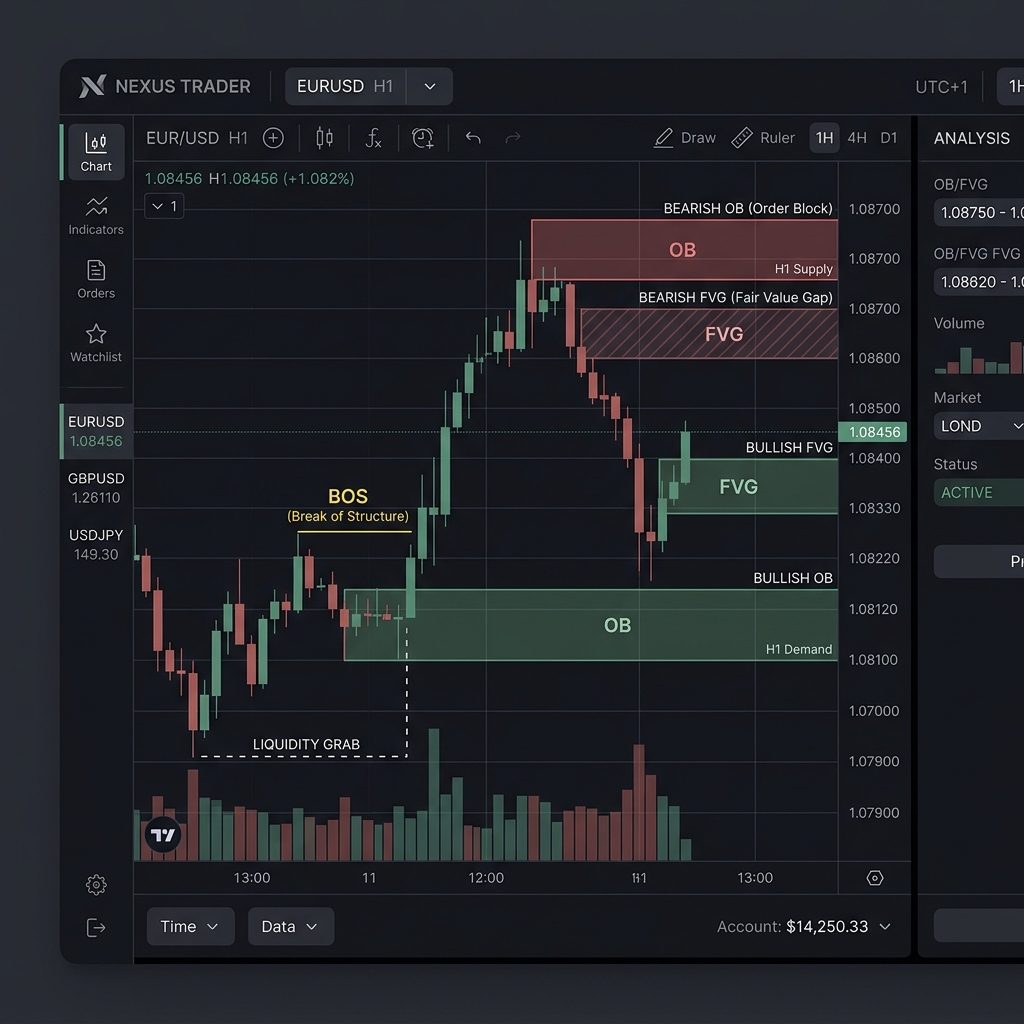
The ICT Silver Bullet setup is one of the SMC trading strategies systematized by Michael Huddleston of ICT (Inner Circle Trader). It is a time-based strategy that combines a liquidity sweep with a Fair Value Gap (FVG) occurring within a one-hour window, three times per day. This article covers the definition, entry conditions, JST-converted time windows, and common pitfalls that beginners tend to overlook.
Definition / Mechanics
The ICT Silver Bullet setup (hereafter “SB”) is built around the following three core concepts.
① Time Restriction (Window)
SB is premised on the rule that it is only valid within a designated window. Three one-hour windows are defined per day. Signals occurring outside these windows do not meet SB criteria, making time management one of the core elements of the setup. Waiting across window boundaries or reusing FVGs that formed before or after the window falls outside the SB definition.
② Liquidity Sweep
After the window opens, the first trigger is a move in which price temporarily exceeds the recently formed Buy-side Liquidity (a cluster of recent highs) or Sell-side Liquidity (a cluster of recent lows) to absorb liquidity. In ICT terminology this is called a “sweep,” and it is interpreted as the result of large participants briefly pushing price to absorb stop orders.
③ Fair Value Gap (FVG) Formation and Entry
Immediately after the sweep, across three consecutive 1-minute or 5-minute candles, the middle candle becomes an impulse move (a sharp rise or fall), creating a gap zone (FVG) that does not overlap with the candles on either side. In SB, the entry point is when price retraces into this FVG. The stop loss (SL) is placed a few pips beyond the sweep extreme, and the take profit (TP) targets the nearest structural level or the opposite edge of the FVG. ICT’s official materials indicate a minimum risk-to-reward ratio of 1:2.
Examples / Calculations / Charts
The 3 Time Windows Converted to JST
SB time windows are defined in EST (US Eastern Standard Time). The conversion to Japan Standard Time (JST = UTC+9) shifts by one hour between the US daylight saving period (EDT: UTC-4) and winter time (EST: UTC-5).
| Window | EST (Winter) | JST (Winter) | JST (Summer / EDT) |
|---|---|---|---|
| London Open SB | 03:00–04:00 | 17:00–18:00 | 16:00–17:00 |
| NY AM Session SB | 10:00–11:00 | 00:00–01:00 (next day) | 23:00–00:00 |
| NY PM Session SB | 14:00–15:00 | 04:00–05:00 | 03:00–04:00 |
For residents in Japan, the easiest window to monitor in real time is the London Open SB (evening, around 16:00–18:00). The two NY session windows fall in the late-night to early-morning hours, so setting price alerts or using an EA for assistance is a practical option for real-time monitoring.
Example Entry Procedure (XAUUSD scenario – hypothetical figures)
The following is an illustration of the London Open SB applied to XAUUSD (Gold). The figures are hypothetical and are intended to explain the structure of the setup, not to represent any specific outcome.
- Confirm window open at 17:00 JST
- Identify the most recent low (e.g., 2,310.00) as Sell-side Liquidity (SSL)
- At 17:10 JST, price sweeps below SSL at 2,310.00
- Confirm an FVG forming on the 5-minute chart between 2,310.50 and 2,311.80
- Place a buy limit order (MIT) near the FVG midpoint (2,311.15)
- SL: 2,309.70 (sweep low minus 3 pips); TP: 2,314.50 (nearest structural level)
- If no setup appears by 18:00 JST, take no trade
In this example, the risk-to-reward ratio is approximately 1:2.3, with an SL of roughly 145 pips versus a TP of roughly 335 pips. For metrics to evaluate gold-focused strategies, see also Key Metrics for Evaluating Gold EAs.
Common Pitfalls for Beginners
- Treating an out-of-window FVG as an SB setup
SB applies only to FVGs caused by a liquidity sweep within the window. Fade trades into FVGs that formed before the window opened, or into FVGs that arose without a preceding sweep, are not SB setups – they are entirely different setups. Removing the time condition destroys the logical foundation of the setup and significantly reduces win-rate reproducibility. - Placing the stop loss exactly at the sweep extreme
After a liquidity sweep, a “wick test” – a secondary approach toward the sweep extreme before price returns to the FVG – can occur. Placing the SL exactly at the extreme often results in being stopped out on that test; ICT suggests a buffer of 2-5 pips. It is important to factor in the real cost including spread and slippage when setting the level. - Using a quoted win rate directly as an expected-value figure
Win-rate figures for SB circulated on social media and in videos vary widely depending on the instrument, timeframe, data period, and how the window definition is interpreted. ICT’s publicly available materials contain virtually no explicit statistical data, and independent re-testing by individuals often produces very different results. Adopting someone else’s figures as your expected value requires your own forward test under identical conditions. - Not designing a position-sizing plan
SB places heavy emphasis on risk-to-reward ratio, but without defining a risk percentage per trade relative to account balance, consecutive losses can cause capital drawdown of an unexpected magnitude. The real reason drawdowns run deep often comes down to the absence of a sizing plan. - Missing the daylight saving time transition
When the US daylight saving time transition occurs (second Sunday of March to first Sunday of November each year), the JST-converted windows shift by one hour. If a broker’s server time is based on GMT or Central European Time, an additional conversion is required. The mistake of concluding that “no signal appeared” simply because the time was not updated is genuinely common.
FX AI Lab’s View
The ICT Silver Bullet setup is a logical framework combining three elements: time window, liquidity, and FVG. While the structure of the setup is clear, assessing reproducibility requires per-instrument forward testing, and directly applying backtest figures to live trading is not advisable. Our lab is currently developing and testing an EA based on the same time-window and liquidity concepts on an HFM demo account, and we are accumulating data. At this stage we publish it as “verification data,” not confirmed “results.” For details or to get involved, please use Contact Us; for setting up a demo environment, see Open an HFM Account.
Related Links
This article is provided for informational purposes only and does not constitute a recommendation to invest or trade any specific instrument. FX and CFD trading carries the risk of losses exceeding your initial deposit. Please read the Risk Disclosure before placing any trades.