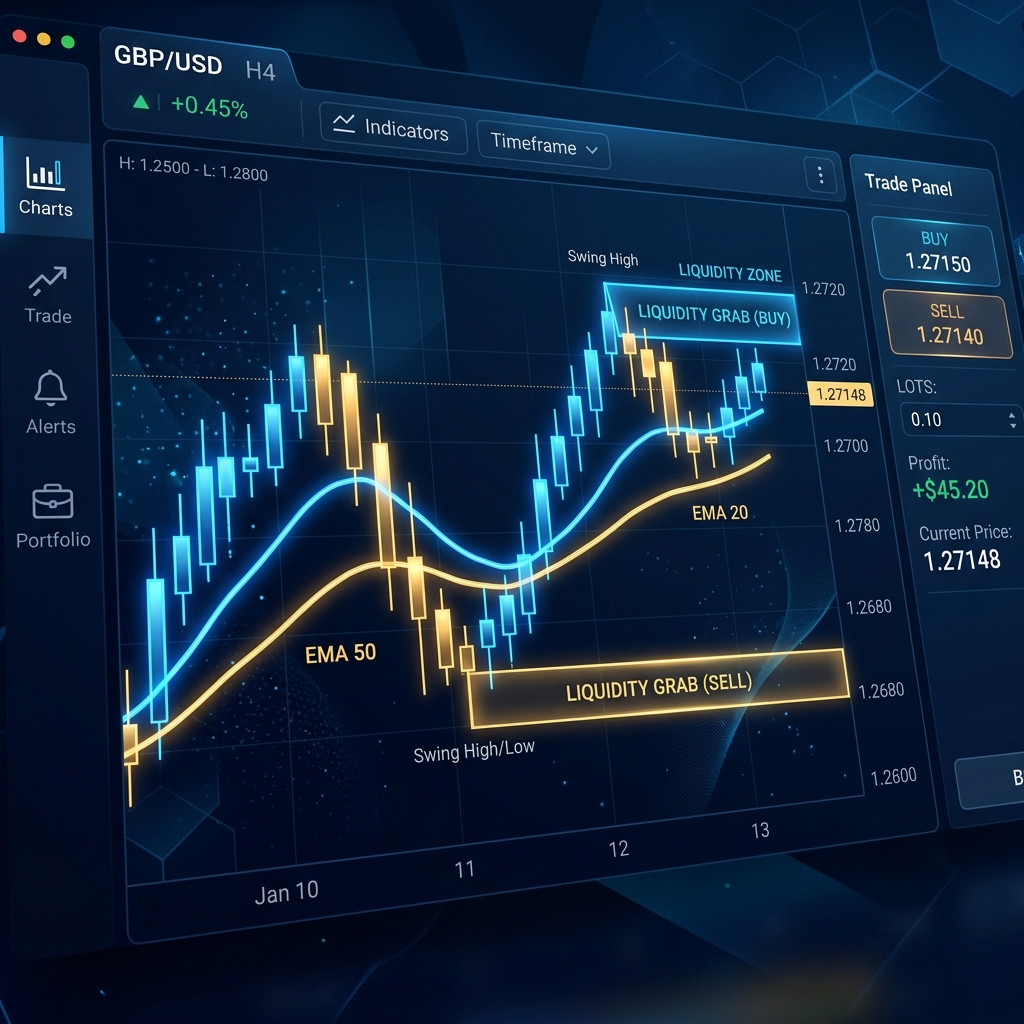
When you search for “what time does the Judas Swing occur,” you’ll find that different sources describe the timing in wildly different ways, which makes the topic confusing. This article lays out the definition of the ICT Judas Swing, precise conversions of the London and New York kill zone times into Japan Standard Time (JST), and the pitfalls that beginners commonly fall into — all organized from our lab’s perspective.
What Is the Judas Swing? Its Definition and Place in the AMD Model
The Judas Swing is a term used within the ICT (Inner Circle Trader) methodology, referring to a “false initial move” that occurs near a session’s opening price. The name comes from Judas, who betrayed Jesus in the New Testament — the idea being that if you trust that first move and open a position on it, you’ll be “betrayed” moments later.
ICT includes a framework called the Power of Three (the AMD model), which breaks a day’s price action into three stages: Accumulation (consolidation around the midpoint, typically during the Asian range), Manipulation (the false initial move), and Distribution (the move in the true direction). The Judas Swing refers specifically to that second stage, Manipulation.
In concrete terms, it’s described as a price pattern in which the high or low of the narrow range formed during the Tokyo session gets pierced just once, with a wick, right after the London or New York session opens — and price then reverses to the opposite side of that range. In our lab’s SMC explainers, we treat the reversal that follows this piercing as a liquidity grab, and the Judas Swing is one form of it. It’s also worth keeping in mind that this isn’t an official term defined by any exchange; it’s a rule of thumb systematized by ICT, an individual trader, and popularized among his followers. We cover the full picture of this terminology in our SMC hub.
Judas Swing Timing in Practice: A JST Conversion Table
The kill zones described in ICT materials are always given in New York (NY) local time. To convert to Japan time: during U.S. Standard Time (EST), “JST = NY time + 14 hours”; during Daylight Saving Time (EDT, roughly mid-March to early November), “JST = NY time + 13 hours.” Because Japan does not observe daylight saving time, only the JST figures shift by one hour, twice a year, in step with the U.S. clock change. The main time windows convert as follows.
| Kill Zone (ICT, NY time) | JST (approx., U.S. Standard Time) | JST (approx., U.S. Daylight Time) |
|---|---|---|
| Asian Range 20:00-24:00 | 10:00-14:00 | 9:00-13:00 |
| London Kill Zone 02:00-05:00 | 16:00-19:00 | 15:00-18:00 |
| NY Kill Zone (AM) 07:00-10:00 | 21:00-24:00 (0:00 next day) | 20:00-23:00 |
The Asian range is essentially the ICT world’s way of describing the consolidation that forms during Tokyo trading hours, and it’s said that stop-loss orders (liquidity) tend to build up near the lows and highs during this period. A typical Judas Swing pattern, for example, would be price breaking above this range’s high once right at the start of the London kill zone (around 16:00 JST during Standard Time), then reversing toward the range’s low (these figures are illustrative only and don’t imply the same price range or timing occurs every time).
Four Common Pitfalls for Beginners
Even if you memorize the time windows precisely, getting the execution wrong defeats the purpose. Here are four common mistakes our lab has observed.
- Ignoring the daylight saving time shift. Because Japan has no daylight saving time, if you’re unaware of the U.S. switch between Standard and Daylight Time, you can end up memorizing the kill zones’ JST times as fixed values that are actually off by an hour.
- Reflexively jumping on the first move. The Judas Swing is, by definition, a pattern where following the initial move gets you “betrayed.” Rather than reacting simply because the range was broken, you need to wait for confirmation signs of a reversal, such as a shift in market structure (BOS/CHoCH).
- Assuming it appears every single day without fail. The Judas Swing is a pattern observed as a rule of thumb, not a rule defined by any exchange. On days disrupted by economic data releases, or when the Asian range is extremely narrow, price may not follow the textbook pattern.
- Using the time window alone as justification for increasing lot size or tolerating larger unrealized losses. Increasing your position size beyond normal just because “it’s an active time of day,” or trying to average down (nanpin) through adverse unrealized losses, is a separate issue from time-window analysis and can lead to significant losses.
Our Lab’s Perspective
Our position is that these time windows and price patterns should be treated as something to be tested, not taken on faith. Our EA, “SMC Gold Sniper,” which codifies SMC concepts of liquidity and market structure into rules, is currently being validated through forward testing using metrics such as the profit factor, and we are also preparing a copy-trading service for it. Before rushing to a decision based on time of day alone, we recommend confirming both verification data and sound money management together.
Related Links
This article is not investment advice; it is intended to share our lab’s analysis and verification findings. The ICT Judas Swing is a price pattern observed as a rule of thumb and does not guarantee future price movements or profits. Offshore brokers (such as HFM) carry high-leverage risk, and our lab treats trading with them as a small-scale, high-risk testing allocation. Forex trading and automated trading can result in losses, so please trade only with disposable funds and at your own discretion and responsibility.