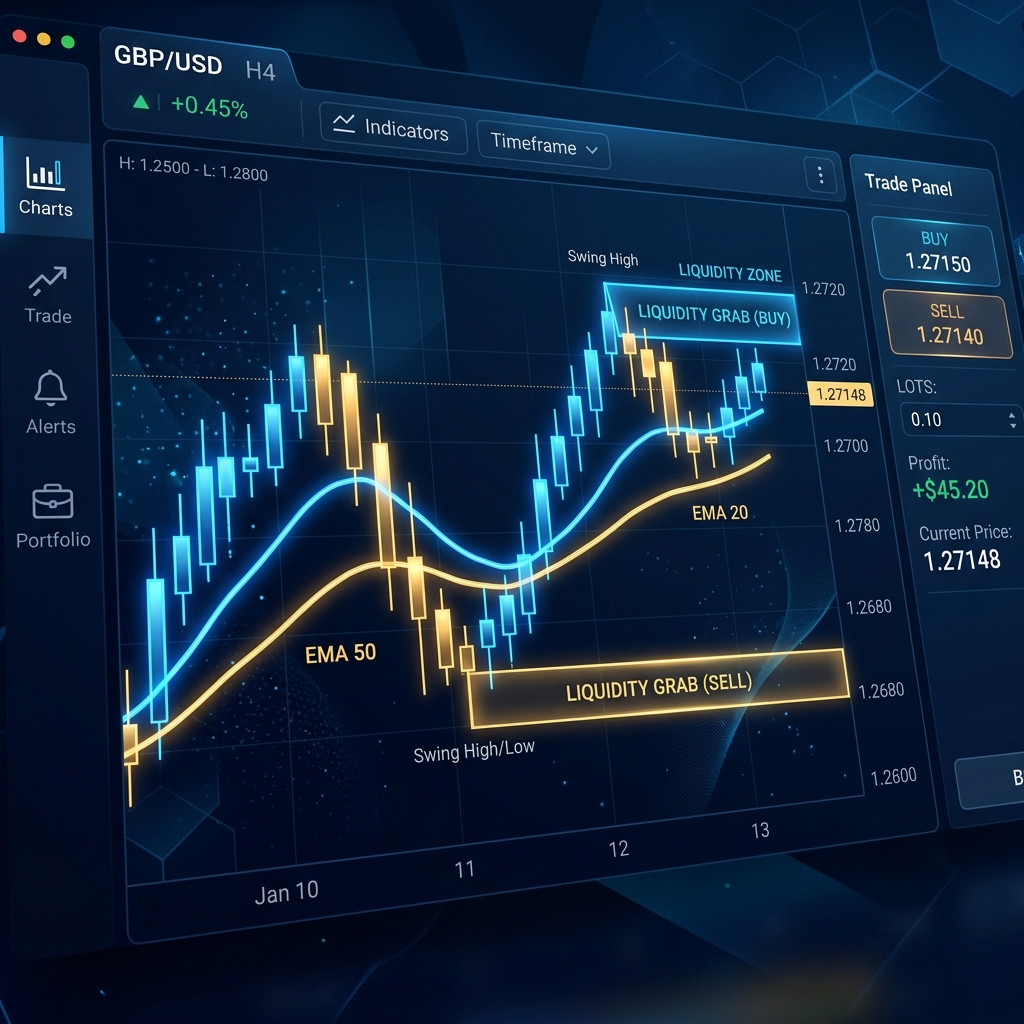
Does this sound familiar: you keep a trading journal every day, yet your performance never improves? There is a large gap between recording and analyzing, and identifying error patterns accurately through subjective review alone is genuinely difficult. This article explains practical methods and key considerations for using generative AI to analyze your trading journal and turn accumulated records into a quantitative improvement cycle.
Generative AI and the Trading Journal: Definitions and How It Works
A trading journal is a historical ledger of your trades, capturing entry price, exit price, lot size, profit/loss, entry rationale, exit rationale, market conditions, and emotional state. Its value lies not in recording P&L alone, but in preserving “why you made each decision” so that patterns can be extracted later.
Generative AI (large language models such as ChatGPT or Claude) can parse text written in natural language and perform summarization, classification, and hypothesis generation. Combining both creates the following analysis flow.
- Record Phase: Accumulate logs as text or CSV that include entry rationale and emotional state
- Input Phase: Paste the logs into generative AI and provide analysis instructions (a prompt)
- Extraction Phase: The AI articulates winning patterns, losing patterns, emotional triggers, and more
- Improvement Phase: Reflect the extracted hypotheses in your next set of trading rules, then return to recording
The key framing is this: AI does not make trading decisions. It is a support tool that articulates and structures the human decision-making process.
Practical Examples, Formulas, and Analytical Metrics
Sample Prompt (Ready-to-Use Template)
Below is my FX trading journal for the past 30 days (includes date, currency pair, direction, P/L in pips, entry rationale, and emotional notes).
[Paste log here]

Please analyze it from the following angles:
1. Common entry-rationale patterns in losing trades
2. Win-rate distribution by day of week and time of day
3. Average P/L for trades where the emotional note contains "rushed" or "FOMO"
4. Three specific hypotheses for improvement
In response to this prompt, generative AI can extract quantitative trends from qualitative notes and surface correlations that are easy for humans to miss. However, all output must be verified against the source data.
Key Metrics to Calculate from Your Journal
| Metric | Formula | Benchmark / Notes |
|---|---|---|
| Win Rate | Winning trades / Total trades x 100 | Meaningless on its own — always use together with Profit Factor |
| Profit Factor (PF) | Total profit / Total loss | Sustaining 1.3 or above is a common validation benchmark |
| Average Risk/Reward Ratio (R:R) | Average profit / Average loss | Below 1.0 means a win rate above 60% is mathematically required |
| Maximum Consecutive Losses | Longest streak of losing trades | Use as a baseline for mental management and lot-size design |
For how to interpret Profit Factor and apply it in practice, also see Profit Factor Benchmarks and How to Read Them Correctly.
Common Pitfalls for Beginners
- Low-granularity records produce low-quality analysis: Handing AI a journal that only says something like “felt like it would go up” will yield nothing more than the obvious conclusion that “many trades lacked a clear rationale.” A minimum level of detail for entry rationale is something like “confirmed RSI divergence near the 4-hour support line.” Emotional notes can be a single word — “rushed,” “confident,” “hesitant” — but they must not be omitted.
- The risk of trusting AI output without verification: Generative AI can produce plausible-sounding misinformation (hallucinations). Even if an analysis result comes back saying “this pattern has an 85% win rate,” you must develop the habit of tallying the original records yourself to verify it. AI is a support tool for generating hypotheses; incorporating findings into operational rules without backing them with empirical data is not acceptable.
- Stopping at analysis without running the improvement cycle: A hypothesis produced by AI must be formalized as a concrete rule to test over the next 20 to 30 trades, or it will never translate into behavioral change. Do not stop at “I noticed something.” Deliberately design the loop of hypothesis, experiment, and re-recording.
- Using loss-analysis results to justify increasing risk: It is dangerous to interpret an AI observation such as “average loss was larger during sessions with consecutive losses” as justification to “double the lot size next time to recover.” Journal analysis exists solely to sharpen the precision of your rules; it is never a basis for increasing position size. For the drawdown structure inherent in martingale and compounding logic, also see The Drawdown Structure of Martingale EAs and Their Serious Risks.
FX AI Lab’s Perspective
At our lab, we are continuously validating structured analysis of trading journals using generative AI alongside autonomous AI trading on demo accounts. Our observations to date show a clear tendency for AI output quality to improve as the granularity of records increases. That said, generative AI analysis is only a starting point for hypotheses; applying it as a decision-making standard in live operation requires a statistically sufficient sample size and empirical backing. The latest validation reports for the EAs and copy-trade signals we are developing and testing are published in our Research Library.
Related Links
This article is provided for informational purposes only and does not constitute a recommendation to invest in any specific financial product. FX trading carries the risk of loss of principal. Before trading, please read our Risk Disclosure carefully and act solely on your own judgment and responsibility.