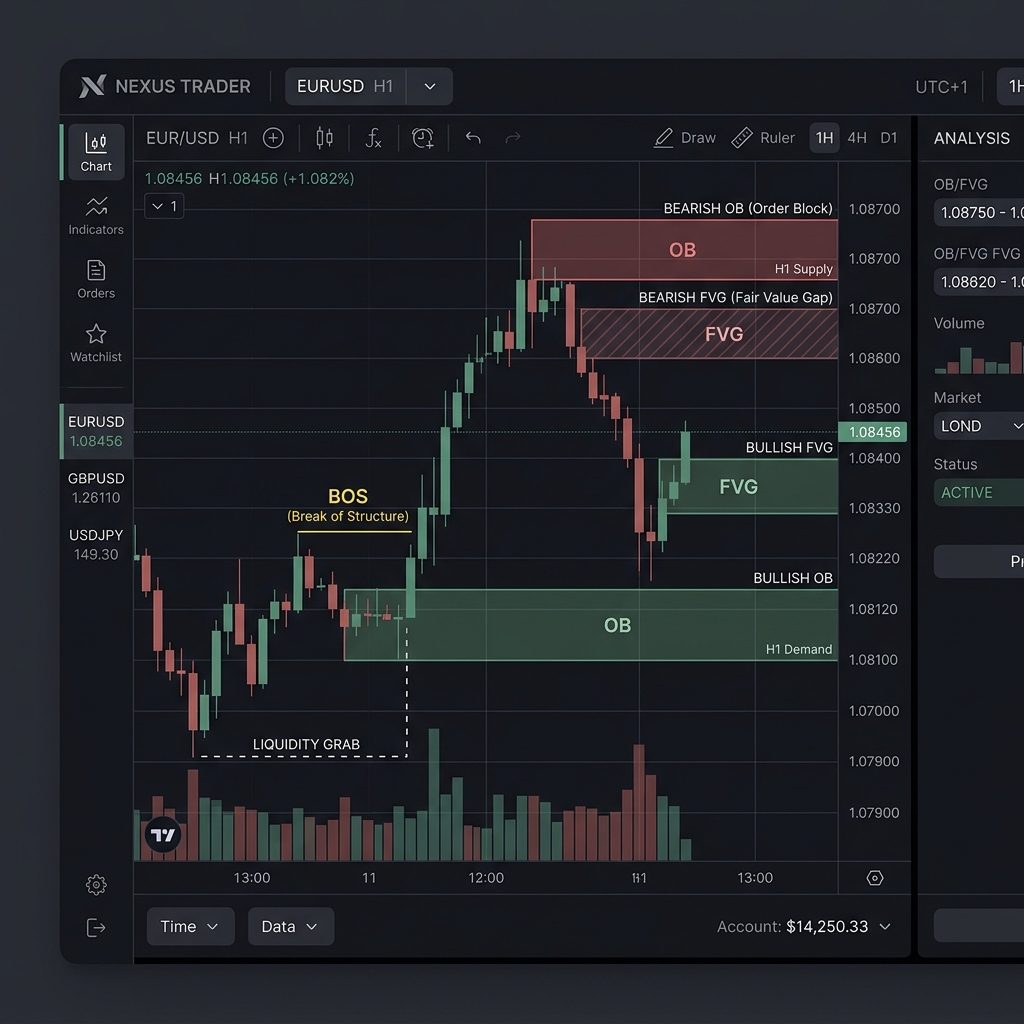
“Guaranteed 30% monthly returns with AI,” “Zero-loss FX automated trading” — Claims like these are appearing with increasing frequency on social media and video platforms. As the FX automated trading market expands, fraudulent products operating under the banner of AI are proliferating as well. This article breaks down the structure of these scams, their specific tactics, and how to read performance figures, providing a framework for distinguishing legitimate products from fraudulent ones.
What Is AI FX Automated Trading and How Do Scams Emerge
FX automated trading (EA: Expert Advisor) refers to a system that automatically places and closes orders based on pre-configured rules or machine learning models. Many products marketed as “AI FX” incorporate statistical models trained on historical price data into their trading logic. Legitimate EAs and reputable copy trading services fall into this category, but fraudulent products using the same terminology are also widely distributed.
Fraudulent products generally fall into three broad categories.
① Fund management by unregistered operators: They accept funds from investors with the explanation that “AI manages the money,” but hold no Financial Instruments Business registration. Most operate as Ponzi schemes that return later investors’ funds as “profits,” collapsing once the operation reaches a certain scale.
② Exaggerated-advertising EA and tool sales: They sell EAs or signal tools at high prices, advertising figures such as “30% monthly returns” or “95% win rate.” Backtest results are over-optimized (curve-fitted), and in most cases the systems do not perform in live markets.
③ Coaching and investment community type: They charge monthly fees under the guise of teaching “AI trading methods,” but disclose no logic or performance data whatsoever. Some cases involve a referral-commission structure dependent on recruiting new members (resembling a multi-level marketing model).
Concrete Examples of Fraudulent Claims and How to Verify Them with Numbers
The figure of “30% monthly returns” becomes clear when calculated on a compounding basis. Compounding 30% monthly over 12 months yields a factor of (1.3)12 ≈ 23.3 times. That means an initial investment of 1,000,000 yen would grow to approximately 23,300,000 yen in one year. Given that even Renaissance Technologies’ Medallion Fund — widely regarded as the world’s top-performing fund — achieved a maximum of 66% annually (before fees, best year on record), it is clear just how unrealistic a claimed monthly return of 30% is.
When performance records are presented, verify them using the following metrics in combination.
| Metric | Description | Reference Level |
|---|---|---|
| Profit Factor (PF) | Total profit divided by total loss | Roughly 1.3 to 1.8 is considered stable |
| Maximum Drawdown (MDD) | Maximum decline from equity peak | Below 20% is preferable |
| Track Record Period | Live-account, live-market track record | At least one year, spanning multiple market conditions |
| Number of Trades | Whether the sample size is statistically significant | 100 or more |
Benchmarks for each metric are explained in detail in Profit Factor Benchmarks and Evaluation Criteria.
Common Pitfalls for Beginners
- Accepting backtest results alone as proof of performance: A backtest reflects optimization against historical data and offers no guarantee of replicability in future markets. Always verify forward-test records conducted on a live account in live market conditions. Note that records spanning three months or less carry little statistical significance.
- Failing to verify FSA registration: Soliciting FX investments from or managing funds on behalf of Japan residents requires Financial Instruments Business registration. Confirm registration status in advance using the FSA’s “List of Licensed, Permitted, and Registered Operators.” Purchasing services from an unregistered operator means you will have limited recourse through administrative channels even if you suffer losses.
- Being misled by the vagueness of the word “AI”: There is no technical restriction on labeling even a simple moving-average crossover rule-based system as “AI-powered.” Without specific explanations of the input data, decision logic, and learning methodology, there is no way to verify what the system actually does.
- Overlooking the risks of martingale/averaging-down EAs: Strategies that keep adding positions even as unrealized losses mount may show a smooth equity curve in backtests, but the risk of account blow-up rises sharply in trending markets. The structural reasons why drawdowns deepen are explained in detail in Why Martingale/Averaging-Down EAs Experience Deep Drawdowns.
- Not checking refund and cancellation terms before purchasing: Even when a “30-day money-back guarantee” is stated, conditions that are practically impossible to meet — such as “no trades having been executed whatsoever” — are sometimes attached. It is strongly recommended that you read the contract and terms of service in full before purchasing.
FX AI Lab’s Position
Our lab continuously conducts verification of EAs using both live and demo accounts. We make no guarantee of definitive returns for EAs under verification, and maintain a policy of publishing actual measured values — profit factor, maximum drawdown, and others — exactly as they are. Those interested in copy trading are invited to review the latest performance data at HFM Copy Trading Details Page. For individual inquiries, please reach out via Contact Us, and we will respond accordingly.
Related Links
This article is intended for informational purposes only and does not constitute a solicitation to invest in any specific financial product or service. FX trading carries the risk of losing your principal. For details, please refer to Risk Disclosure.